
4,000 holes in a concrete ceiling: tools and tricks that save your shoulders
A worker facing 4,000 overhead holes in concrete asked Reddit's carpentry forum how to get through eight-hour drilling days. Field research and OSHA's silica rule point to two fixes: put the drill on a stand, and pull the dust at the bit.
Few jobsite tasks punish the body like drilling up into concrete. In the usual method, a worker on a ladder or scissor lift holds a hammer drill weighing 20 to 40 newtons (4.5 to 9 pounds) overhead and pushes up with roughly 300 newtons (67 pounds) for about 45 seconds per hole, University of California researchers reported in the Journal of Safety Research in 2010. At that pace, 4,000 holes mean some 50 hours of pushing.
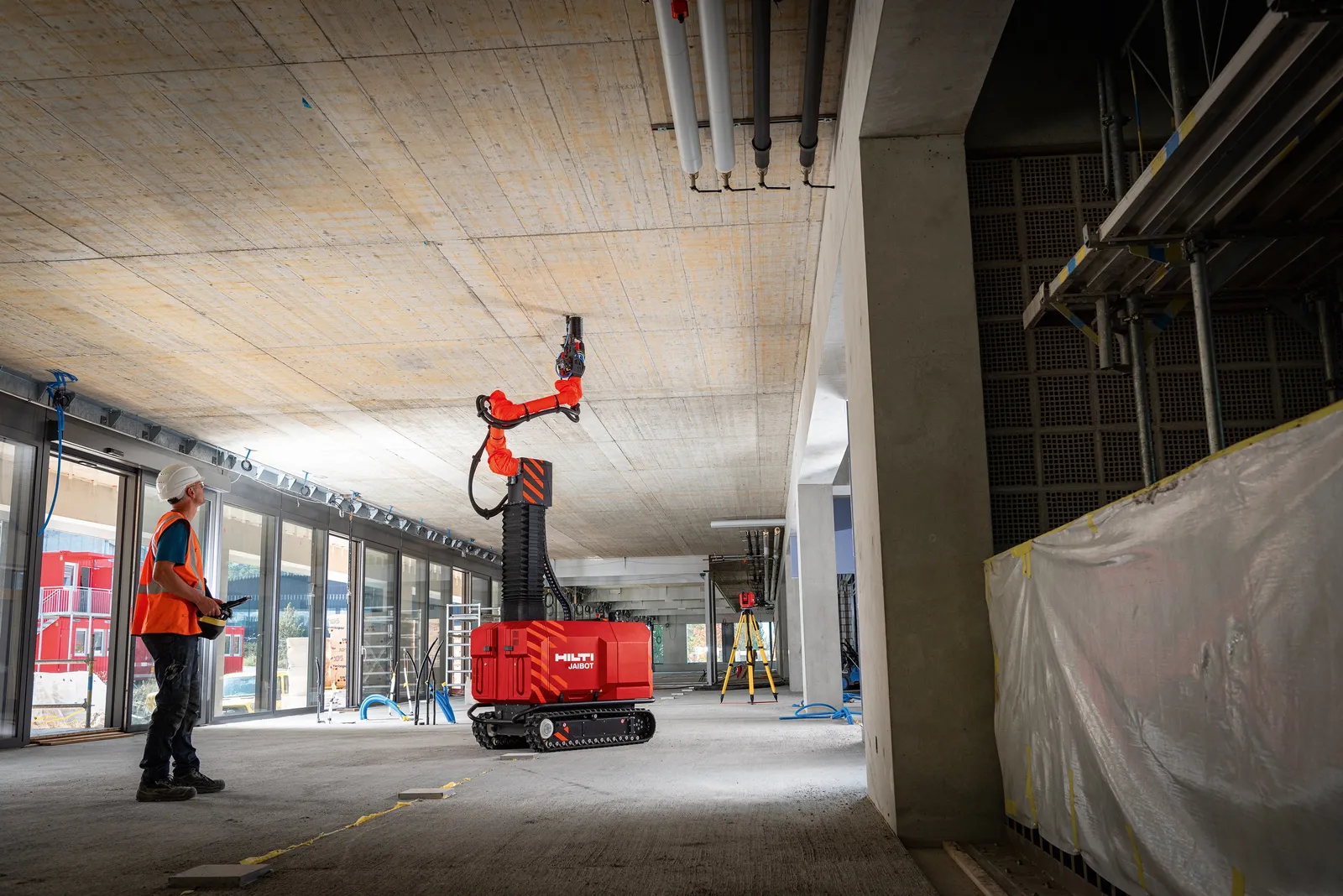
The researchers, working with CPWR and NIOSH, tested wheeled drill stands: a column that holds the hammer drill and raises it with a hand crank. Sixteen electricians, plumbers and carpenters on Portland, Oregon, jobsites rated shoulder fatigue below 1 on a 0 to 5 scale with each of three stands, against 3.7 when drilling by hand. Their favorite, the "Collar Base," locks the column plumb with bubble levels, so layout marks could go on the floor, not the ceiling. Moving the drill away from the face also cut dust, noise and vibration. The limits: ceilings above 3.5 meters (11.5 feet) needed a heavy extension or a lift, and cords and debris slowed the wheels. Hilti offers a robotic version, Jaibot, a tracked machine introduced in 2020 that drills ceiling holes from BIM data and marks each one by trade.
Every hole also throws respirable crystalline silica into the air. Under Table 1 of OSHA's construction silica standard, a handheld or stand-mounted drill needs a shroud at the bit, a vacuum delivering at least the airflow the tool maker recommends, and a filter rated 99% efficient or better with a cleaning mechanism, an OSHA fact sheet says. Holes get cleaned with a HEPA vacuum. Compressed air is out unless ventilation captures the cloud. Indoors, OSHA warns, the vacuum alone may not keep exposure low, and extra exhaust may be needed.
Set up that way, the vacuum can hold drilling under OSHA's limit of 50 micrograms per cubic meter over an eight-hour shift, so no respirator is required, the agency says.
Why it matters: On jobs with hundreds of anchors, price a drill stand or robot and a Table 1 shroud and vacuum into the bid. Hand drilling wears out shoulders, and skipping those controls takes a crew off OSHA's simplest compliance path.
Sources
- Overhead drilling: Comparing three bases for aligning a drilling jig to verticalJournal of Safety Research (PubMed Central), Apr 13, 2010
- Control of Silica Dust in Construction: Handheld and Stand-Mounted DrillsOSHA, Dec 1, 2017
- Hilti unveils BIM-enabled construction jobsite robotHilti Corporation, Oct 28, 2020
- Drilling 4000 holes in concrete ceiling - Advice neededReddit r/Carpentry, Nov 4